Forum Insight2026
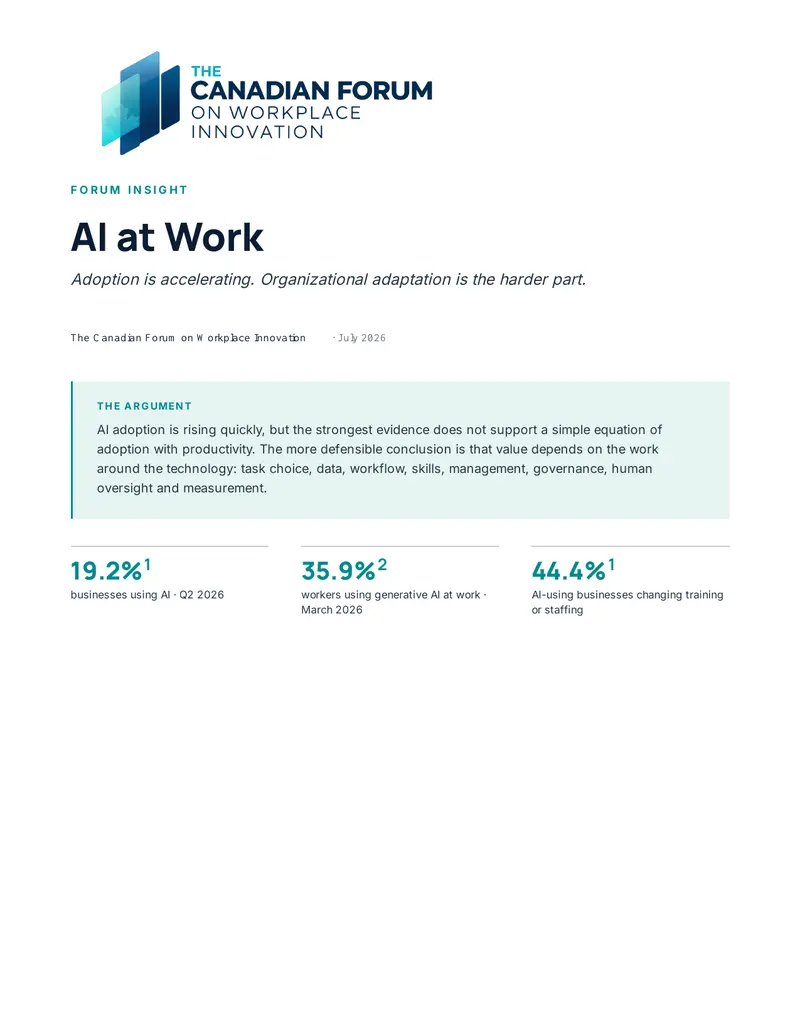
AI at Work
Adoption is accelerating. Organizational adaptation is the harder part.
4 pages · PDF

Flagship report
From workforce pressure to workplace adaptation
Canada’s workforce challenge is no longer only about finding people. It is increasingly about how organizations use skills, technology and work design to make better use of the capacity they have.
September 2026 · 22 pages · Web report + PDF

In one sentence
Canada’s vacancy pressure has eased from the extraordinary levels of 2022, but skill constraints remain, AI adoption is accelerating unevenly, and more Canadians are working later in life. The common organizational challenge is not simply finding more workers; it is adapting how work is designed, how skills are developed, how technology is integrated and how experience is retained.
Summary
What labour-market shifts, artificial intelligence and demographic change mean for how work is designed in Canada. The report examines vacancies and skill constraints, AI adoption, firm-level productivity evidence, workforce aging and work design together, because organizations experience them together.
Findings
The broad vacancy environment is much less tight than in 2022, yet one-quarter of businesses still expect difficulty recruiting skilled employees. This distinction matters: aggregate labour-market easing does not eliminate occupation-, skill-, sector- or location-specific constraints.
Business adoption, planned adoption and worker use are different measures. Adoption is concentrated in some sectors, low in others, and more than half of businesses still report no plans to use AI over the next year.
A 2026 Statistics Canada firm-level study found a large productivity gap between AI adopters and non-adopters in a benchmark model, but the gap narrowed substantially and became statistically insignificant after accounting for pre-existing productivity and complementary capabilities. The study does not establish a causal productivity effect from AI adoption.
More Canadians are working later in life, retirements are rising, and post-retirement work is often part time. The organizational implications include knowledge transfer, flexibility, training and the design of late-career work.
Recruitment, training, technology, schedules, workflows and decision rights interact. The practical challenge is to diagnose the specific constraint and adapt the work around it rather than defaulting to a single response.
Key measures
2.8%
job vacancy rate
June 2026 · Vacancies as a share of total labour demand
The vacancy rate and the unemployed-to-vacancy ratio are different measures.
2.9
unemployed people for every job vacancy
June 2026 · Unemployed persons per vacancy
A ratio, not a rate. Distinct from the 2.8% job vacancy rate.
19.2%
of businesses used AI to produce goods or deliver services
12 months preceding Q2 2026 · Canadian businesses
15.2%
labour-force participation rate, Canadians aged 65 and older
2025 · Canadians aged 65+ — a record high
Contents
Methodology and evidence
This report synthesizes publicly available Canadian labour-market, business, technology, retirement, productivity and working-conditions evidence available through September 1, 2026. Priority is given to Statistics Canada and other official public sources. OECD evidence is used to provide broader productivity context. The report is an evidence synthesis and practical interpretation; it is not a forecast, causal evaluation or sector-specific diagnostic.
Official statistical and regulatory sources are used for core factual claims where available. Survey, think-tank, consulting and international evidence is used as complementary context and is identified by source type. Descriptive associations are not presented as causal effects, and measures with different populations, definitions or reference periods are not treated as directly comparable.
Read the complete methodology section →Access
PDF · 22 pages · Flagship Report
Related
Adoption is accelerating. Organizational adaptation is the harder part.
4 pages · PDF
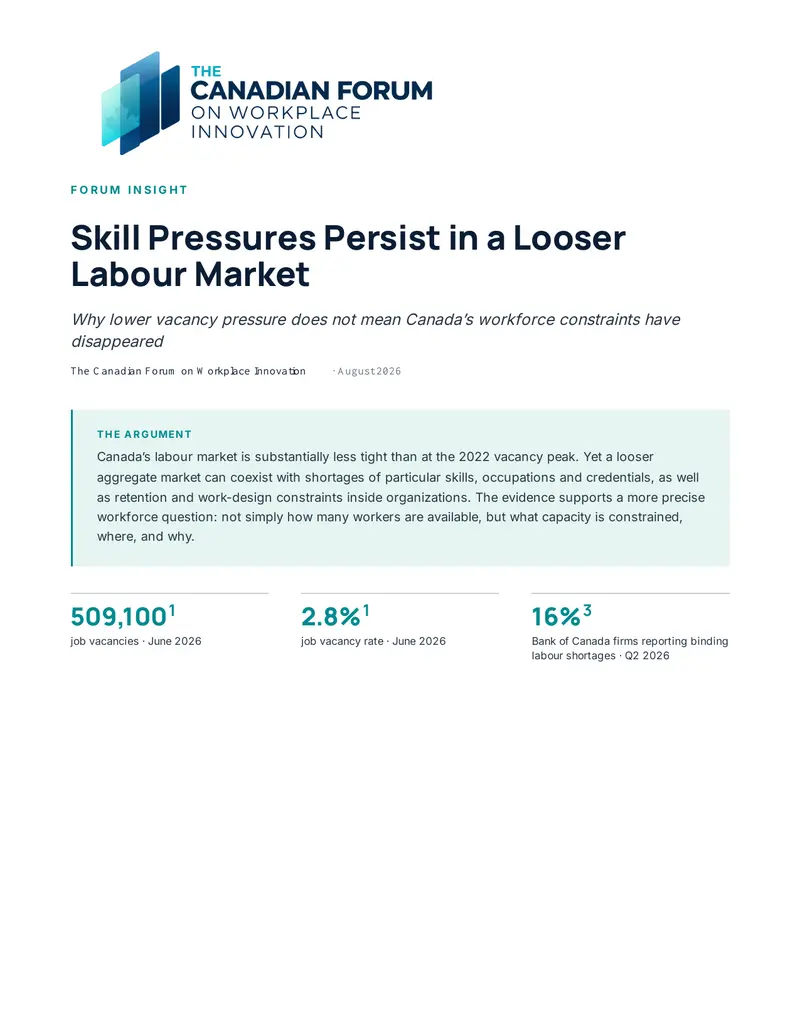
Why lower vacancy pressure does not mean Canada’s workforce constraints have disappeared
5 pages · PDF
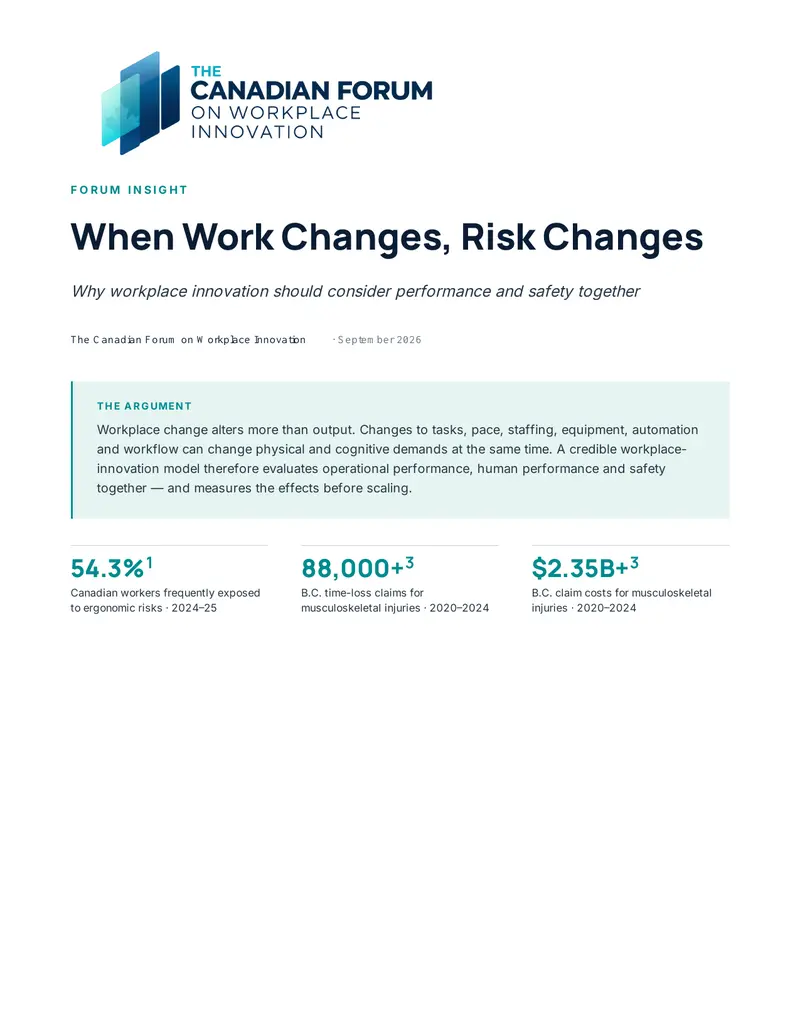
Why workplace innovation should consider performance and safety together
5 pages · PDF
The productivity and cost case for improving how physical work is assessed
9 pages · PDF
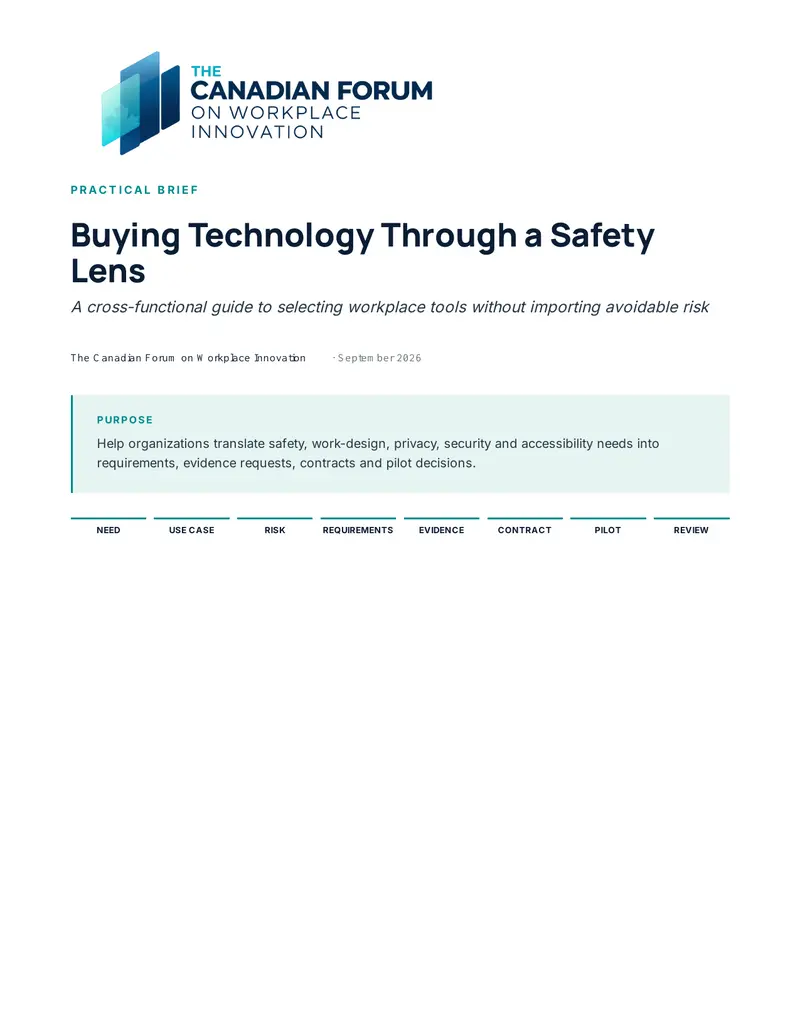
A cross-functional guide to selecting workplace tools without importing avoidable risk
6 pages · PDF
A proportionate path from a real workplace problem to a manageable pilot
6 pages · PDF
A practical review of pace, workload, decision-making, skills and physical demands
6 pages · PDF
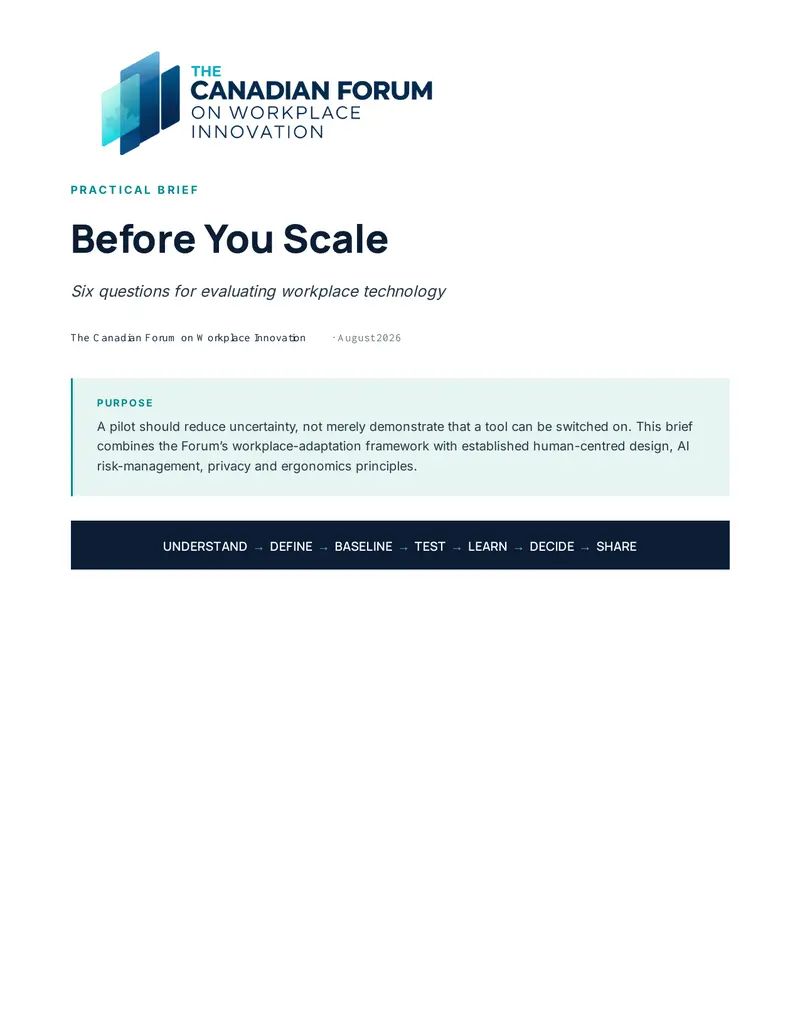
A practical self-assessment before an organization pilots, buys or scales a new tool
7 pages · PDF