Forum Insight2026
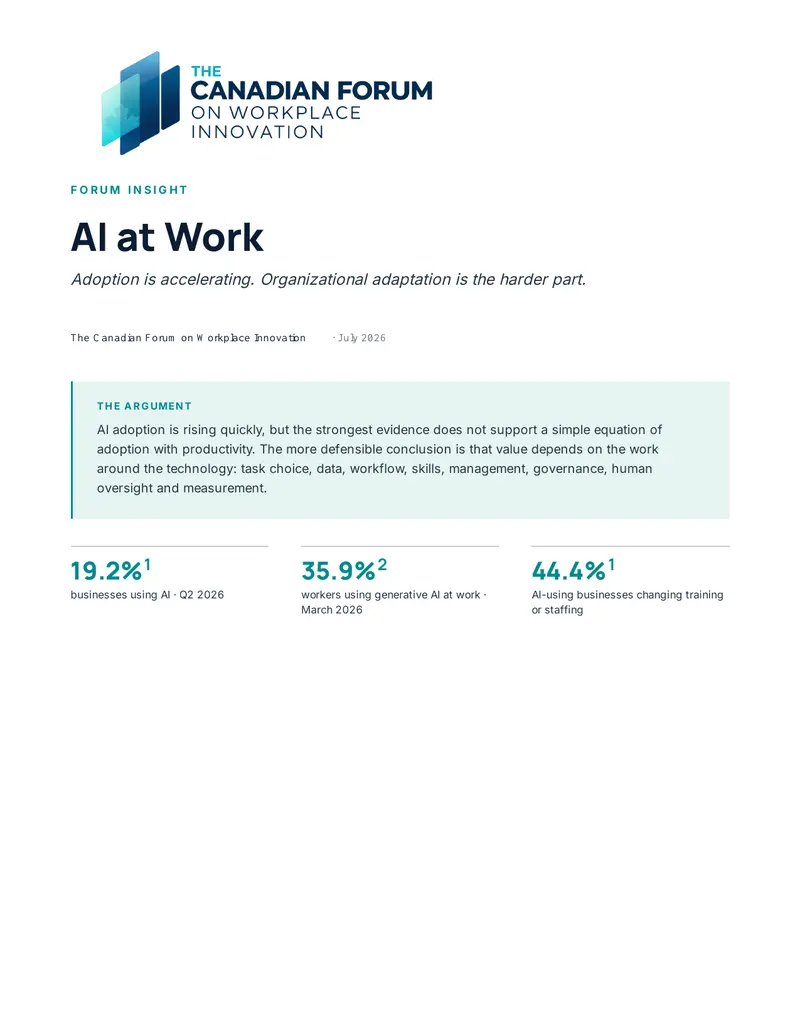
AI at Work
Adoption is accelerating. Organizational adaptation is the harder part.
4 pages · PDF

Forum Insight
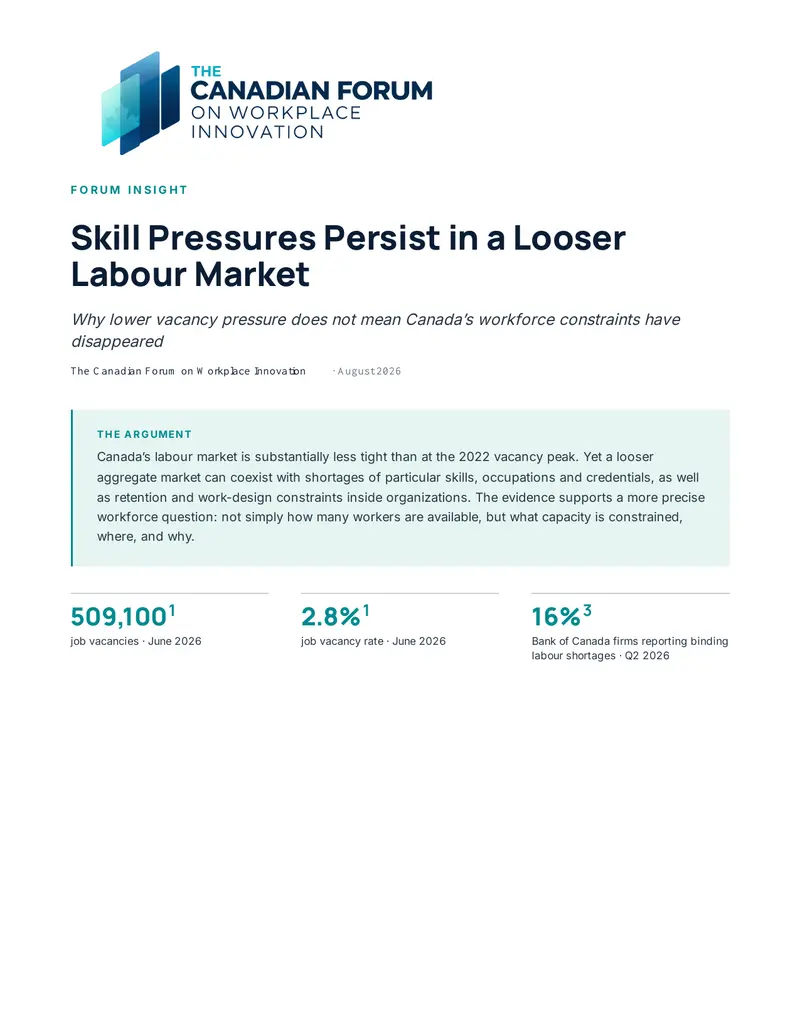
Why lower vacancy pressure does not mean Canada’s workforce constraints have disappeared
Canada’s labour market is less tight than it was at the 2022 vacancy peak, but important skill, occupation, retention and work-design constraints remain. This insight explains why aggregate labour-market conditions do not tell the whole organizational story.
August 2026 · 5 pages · PDF
Publication overview
At a glance
509,100
job vacancies in Canada
June 2026 · All Canadian payroll employers
2.9
unemployed people for every job vacancy
June 2026 · Unemployed persons per vacancy
A ratio, not a rate. Distinct from the 2.8% job vacancy rate.
25.2%
of businesses expected recruiting skilled employees to be an obstacle
Q3 2026 (next three months) · Canadian businesses — expectations, not a measured shortage
Summary
A looser aggregate labour market can coexist with shortages of particular skills, occupations and credentials, as well as retention and work-design constraints inside organizations. The evidence supports a more precise workforce question: not simply how many workers are available, but what capacity is constrained, where, and why.
The national labour market has loosened
Key findings
Job vacancies averaged 942,600 in 2022 and the vacancy rate peaked at 5.4%. By June 2026, vacancies stood at 509,100 and the vacancy rate was 2.8%, with 2.9 unemployed people for every vacancy — compared with a ratio that fell as low as 1.0 in June 2022.
In Q3 2026, 25.2% of businesses expected recruiting skilled employees to be an obstacle over the next three months, and a separate Q1 2026 analysis found 35.1% had experienced difficulty finding candidates with the skills needed during the previous 12 months.
Headcount, skills, retention and work-design constraints require different responses. Better decisions start by diagnosing which bottleneck is actually present.
Contents
Evidence and sources
Official monthly vacancy indicators.
Historical 2022 vacancy level and vacancy-rate peak.
Bank of Canada, Business Outlook Survey, Q2 2026
Independent firm-survey evidence on binding labour shortages and capacity.
Statistics Canada, Canadian Survey on Business Conditions, third quarter 2026 (opens in a new tab)
Expected obstacles related to recruiting skilled employees.
Statistics Canada, Analysis on employee skills gaps, first quarter of 2026 (opens in a new tab)
Candidate-skill difficulties, in-house training, mentoring or coaching, and training associated with technology adoption.
OECD, Employment Outlook 2026: Canada
International comparative assessment of Canadian labour-market tightness.
Future Skills Centre / Conference Board, From Shortages to Solutions
Occupation-level analysis of skilled-worker imbalances; model-based estimates.
Future Skills Centre, National Survey on Skill Demands and Employment Practices in SMEs
2025 survey of 1,700 SMEs; complementary employer evidence.
Employment and Social Development Canada, Skill Gaps and the Strategies Used by Employers
2026 publication using the 2021 Survey of Employers on Workers’ Skills; used for structural evidence, not current prevalence.
Official statistical and regulatory sources are used for core factual claims where available. Survey, think-tank, consulting and international evidence is used as complementary context and is identified by source type. Descriptive associations are not presented as causal effects, and measures with different populations, definitions or reference periods are not treated as directly comparable.
Download
PDF · 5 pages · Forum Insight
Related
Adoption is accelerating. Organizational adaptation is the harder part.
4 pages · PDF
Why workplace innovation should consider performance and safety together
5 pages · PDF