Forum Insight2026
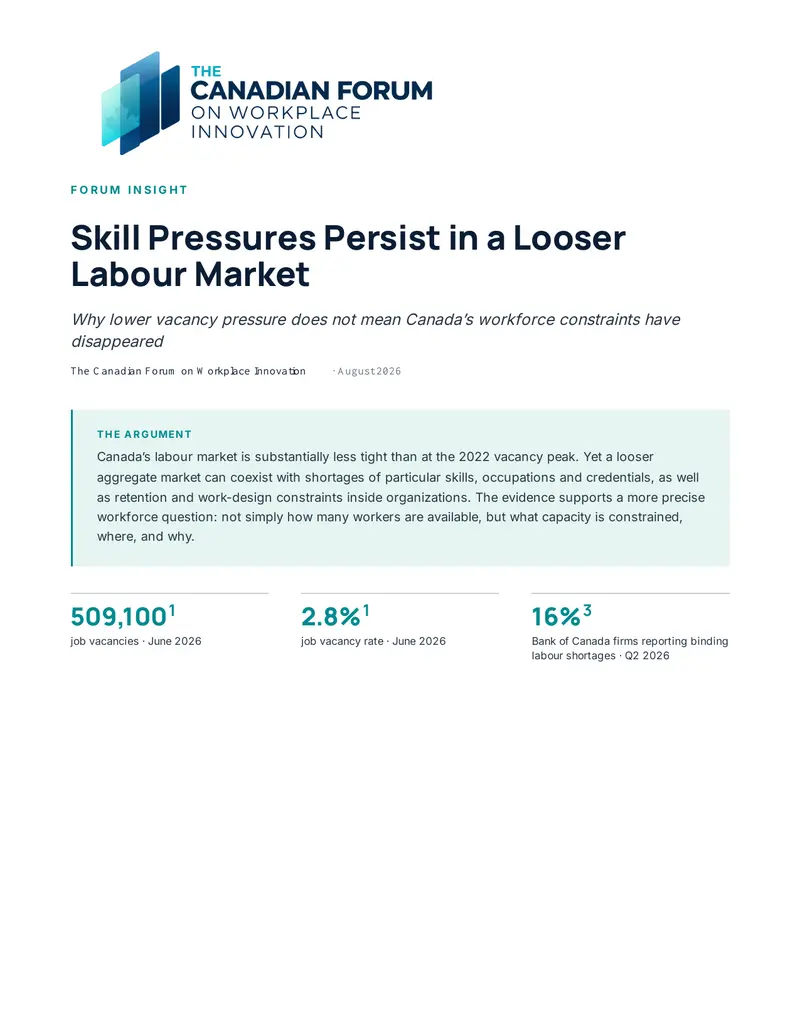
Skill Pressures Persist in a Looser Labour Market
Why lower vacancy pressure does not mean Canada’s workforce constraints have disappeared
5 pages · PDF

Forum Insight
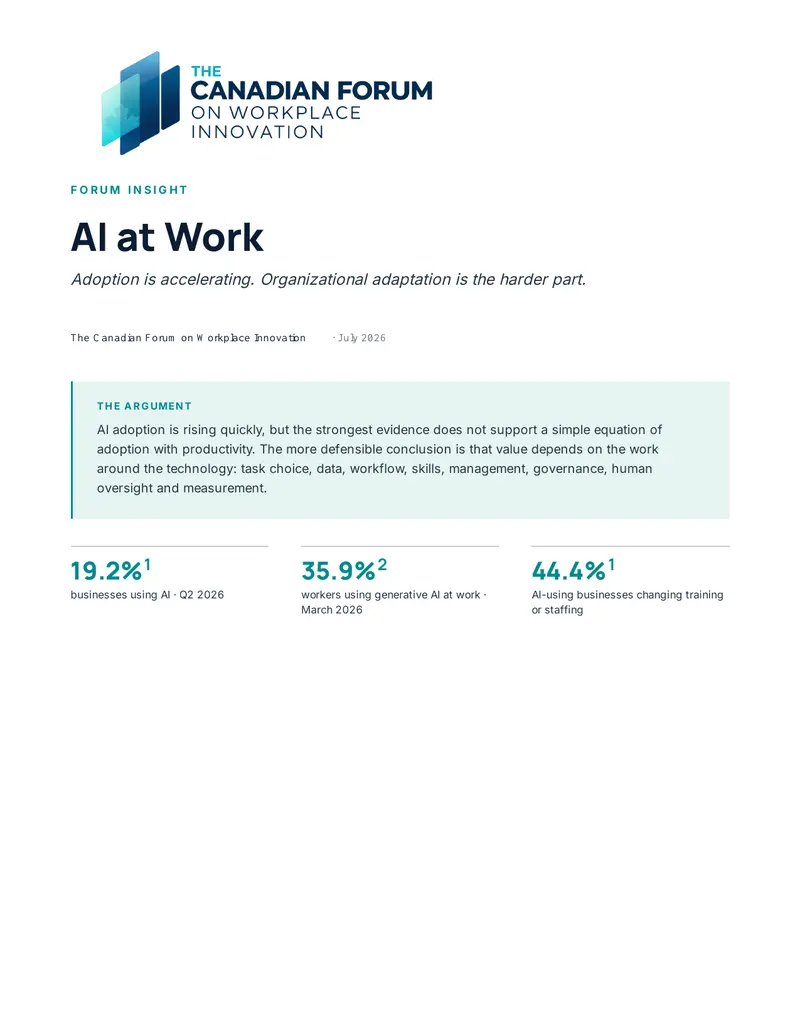
Adoption is accelerating. Organizational adaptation is the harder part.
AI adoption is rising quickly, but adoption alone does not guarantee productivity. This Forum Insight examines the organizational capabilities, work design, training, governance and measurement needed to turn technology adoption into useful outcomes.
July 2026 · 4 pages · PDF
Publication overview
At a glance
19.2%
of businesses used AI to produce goods or deliver services
12 months preceding Q2 2026 · Canadian businesses
35.9%
of workers reported using generative AI as part of their main job or business
Previous 12 months, March 2026 · Workers aged 15 to 69
Worker generative-AI use and business AI use measure different things.
44.4%
of AI-using businesses made changes to training or staffing practices because of AI use
Q2 2026 · Canadian businesses that used AI in the previous 12 months
Summary
AI adoption is rising quickly, but the strongest evidence does not support a simple equation of adoption with productivity. The more defensible conclusion is that value depends on the work around the technology: task choice, data, workflow, skills, management, governance, human oversight and measurement.
Adoption is accelerating — but the measures are different
Key findings
In Q2 2026, 19.2% of businesses reported using AI to produce goods or deliver services in the previous 12 months, up from 12.2% in Q2 2025 and 6.1% in Q2 2024. Separately, 35.9% of workers aged 15 to 69 reported using generative AI in their main job in March 2026. These measure different things and are not competing adoption rates.
A 2026 Statistics Canada firm-level study found AI adopters had labour productivity 16.8% higher than non-adopters in a benchmark specification; 10.2% after controlling for initial productivity; and 5.1% and no longer statistically significant after controls for complementary capabilities. This is association, not a causal return from adoption.
Among Canadian businesses that had used AI, 44.4% reported changes to training or staffing practices. Among AI-using businesses with 100 or more employees, 68.1% trained employees and 51.7% trained executives.
Contents
Evidence and sources
Official national business adoption and implementation measures.
Official worker-level generative-AI use.
Firm-level observational productivity analysis.
OECD, AI and Skills (2026)
International evidence on skills, training and worker outcomes.
International Labour Organization, Generative AI and Jobs: A 2025 Update
Task-level occupational exposure and transformation framing.
Deloitte Canada, State of AI in the Enterprise 2026
Canadian executive survey used for implementation context, not national prevalence.
Office of the Privacy Commissioner of Canada, Protecting Employee Privacy in the Modern Workplace
Canadian privacy-regulator guidance on workplace AI and monitoring.
NIST, AI Risk Management Framework / AI Resource Center
Risk-management, testing, evaluation, verification and validation framework.
Official statistical and regulatory sources are used for core factual claims where available. Survey, think-tank, consulting and international evidence is used as complementary context and is identified by source type. Descriptive associations are not presented as causal effects, and measures with different populations, definitions or reference periods are not treated as directly comparable.
Download
PDF · 4 pages · Forum Insight
Related
Why lower vacancy pressure does not mean Canada’s workforce constraints have disappeared
5 pages · PDF
Why workplace innovation should consider performance and safety together
5 pages · PDF