Forum Insight2026
When Work Changes, Risk Changes
Why workplace innovation should consider performance and safety together
5 pages · PDF

Forum Insight
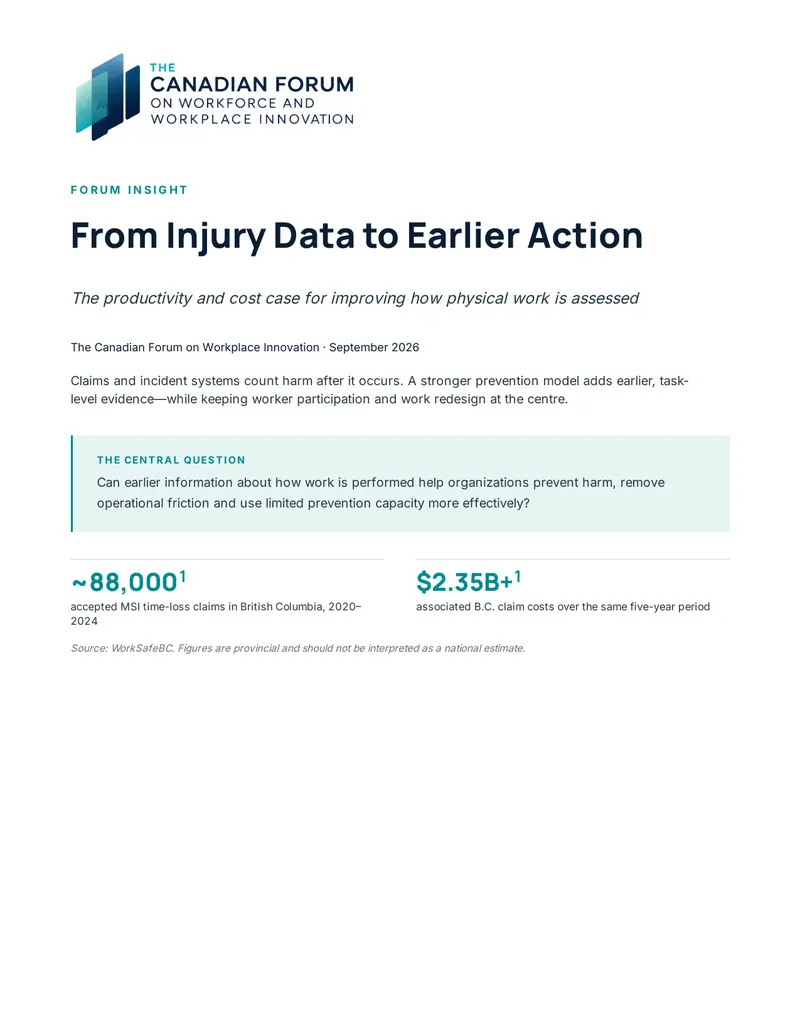
The productivity and cost case for improving how physical work is assessed
Claims and incident systems count harm after it occurs. This Forum Insight examines how earlier, task-level information can complement those systems, strengthen prevention decisions and support a more credible productivity and cost case for improving physical work.
September 2026 · 9 pages · PDF
Publication overview
Summary
Claims and incident systems count harm after it occurs. This Forum Insight examines how earlier, task-level information can complement those systems, strengthen prevention decisions and support a more credible productivity and cost case for improving physical work.
Claims remain essential but cannot fully explain where current task risks and operational friction originate
Key considerations
Compensation and incident systems count harm after it occurs. A stronger prevention model adds earlier, task-level evidence while keeping worker participation and work redesign at the centre.
No single measure explains where risk and friction originate. Earlier information about how work is performed can help organizations prevent harm and remove operational friction.
Earlier, task-level evidence can support a more credible productivity and cost case for improving how physical work is assessed, tested in a bounded pilot before scaling.
Evidence and sources
Complete sources and evidence notes are provided in the publication.
Official statistical and regulatory sources are used for core factual claims where available. Survey, think-tank, consulting and international evidence is used as complementary context and is identified by source type. Descriptive associations are not presented as causal effects, and measures with different populations, definitions or reference periods are not treated as directly comparable.
Download
PDF · 9 pages · Forum Insight
Related
Why workplace innovation should consider performance and safety together
5 pages · PDF
A practical review of pace, workload, decision-making, skills and physical demands
6 pages · PDF
A practical self-assessment before an organization pilots, buys or scales a new tool
7 pages · PDF