Six questions, in sequence
Understand → Define → Baseline → Test → Learn → Decide → Share. Write the problem in operational terms before selecting a product.

Practical Brief
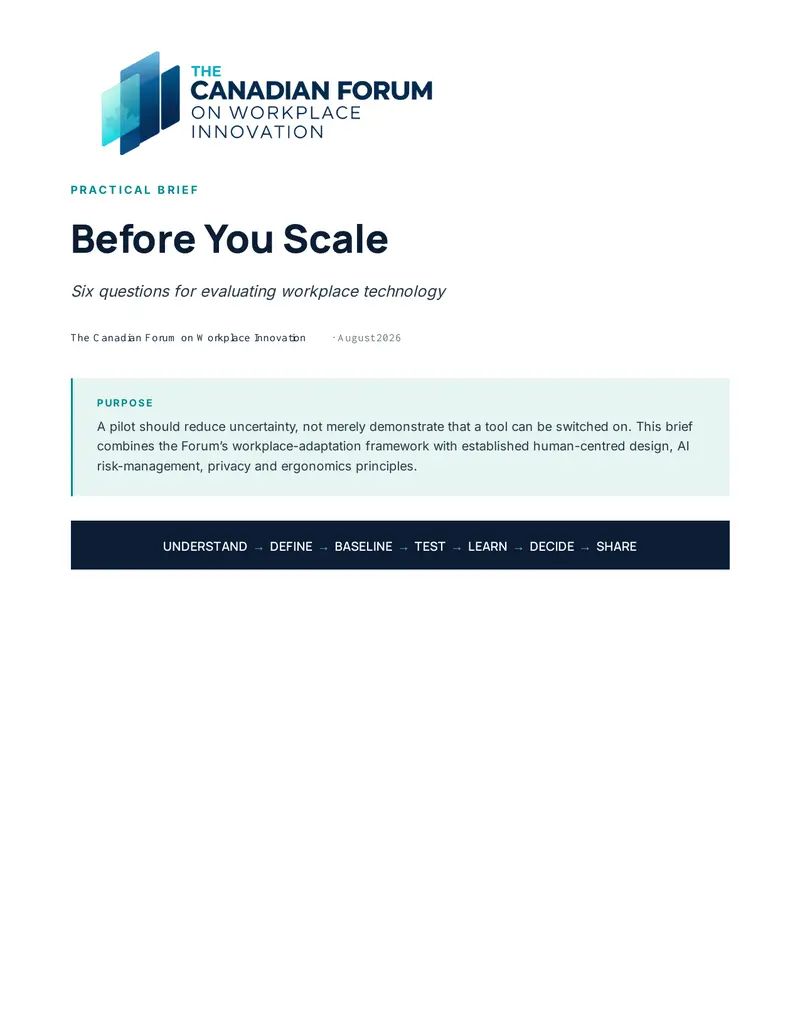
Six questions for evaluating workplace technology
A practical decision framework for organizations evaluating workplace technology. The brief moves from understanding and defining the problem through baseline measurement, testing, learning and the decision to scale, adapt, stop or investigate further.
August 2026 · 5 pages · PDF
Publication overview
At a glance
Understand → Define → Baseline → Test → Learn → Decide → Share. Write the problem in operational terms before selecting a product.
Licences, training, usage and pilot completion show that activity occurred, not that the defined workplace condition changed.
Validate the system in the actual use context, define where human review and override are required, and document data, privacy, error and bias risks.
Summary
A pilot should reduce uncertainty, not merely demonstrate that a tool can be switched on. This brief combines the Forum’s workplace-adaptation framework with established human-centred design, AI risk-management, privacy and ergonomics principles.
Six questions, in sequence
Key findings
Understand → Define → Baseline → Test → Learn → Decide → Share. Write the problem in operational terms before selecting a product, and end with an explicit decision.
Licences, training, usage and pilot completion show that activity occurred. The decision question is whether the defined workplace condition changed, by how much, for whom, and whether the intervention created new burden or risk elsewhere.
Validate the system in the actual use context, define where human review and override are required, and document data, privacy, error and bias risks that could affect workers or decisions.
Contents
Evidence and sources
ISO 6385:2016, Ergonomics principles in the design of work systems
Integrated human-social-technical work-system design.
ISO 9241-210:2019, Human-centred design for interactive systems
ISO 9241-220:2019, Processes for enabling, executing and assessing human-centred design within organizations
ISO 10075-2:2024, Ergonomic principles related to mental workload
Work-system design covering mental workload, health, safety and performance.
NIST, AI Risk Management Framework
AI risk management and evaluation in context.
Federal, provincial and territorial privacy commissioners, Protecting Employee Privacy in the Modern Workplace
NIOSH, Elements of Ergonomics Programs
Task analysis, worker involvement, control selection and evaluation.
ILO, Generative AI and Jobs: A 2025 Update
Task-level transformation and the importance of human input and social dialogue.
Official statistical and regulatory sources are used for core factual claims where available. Survey, think-tank, consulting and international evidence is used as complementary context and is identified by source type. Descriptive associations are not presented as causal effects, and measures with different populations, definitions or reference periods are not treated as directly comparable.
Download
PDF · 5 pages · Practical Brief
Related
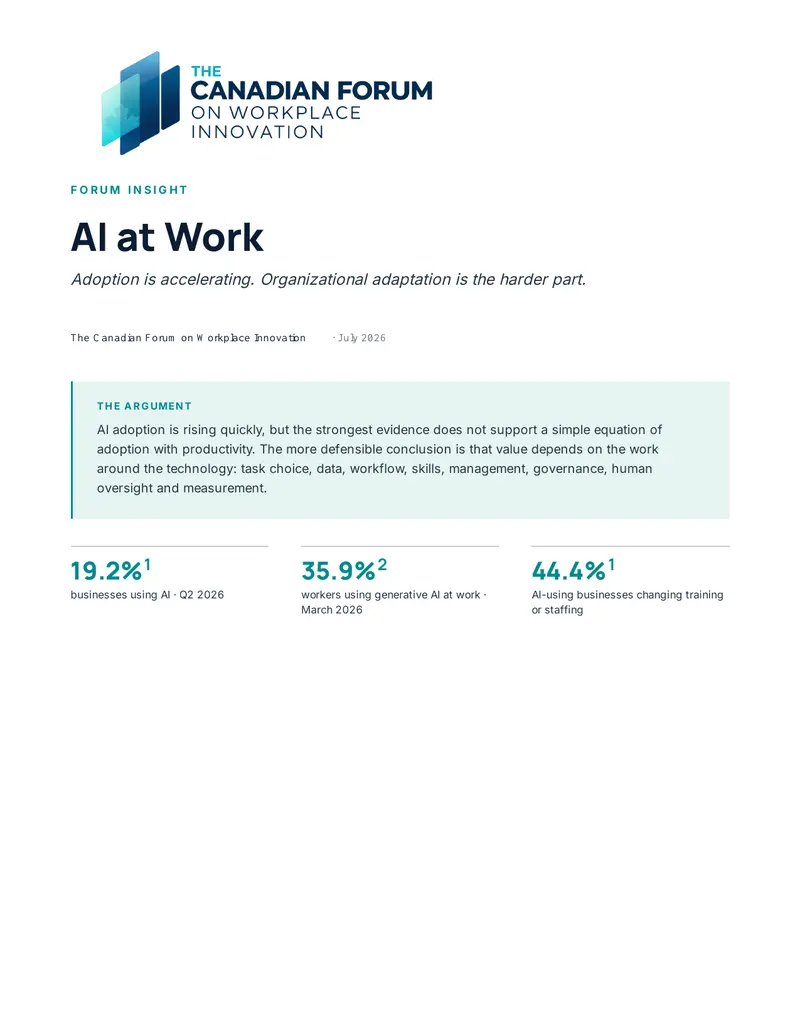
Adoption is accelerating. Organizational adaptation is the harder part.
4 pages · PDF
Why lower vacancy pressure does not mean Canada’s workforce constraints have disappeared
5 pages · PDF
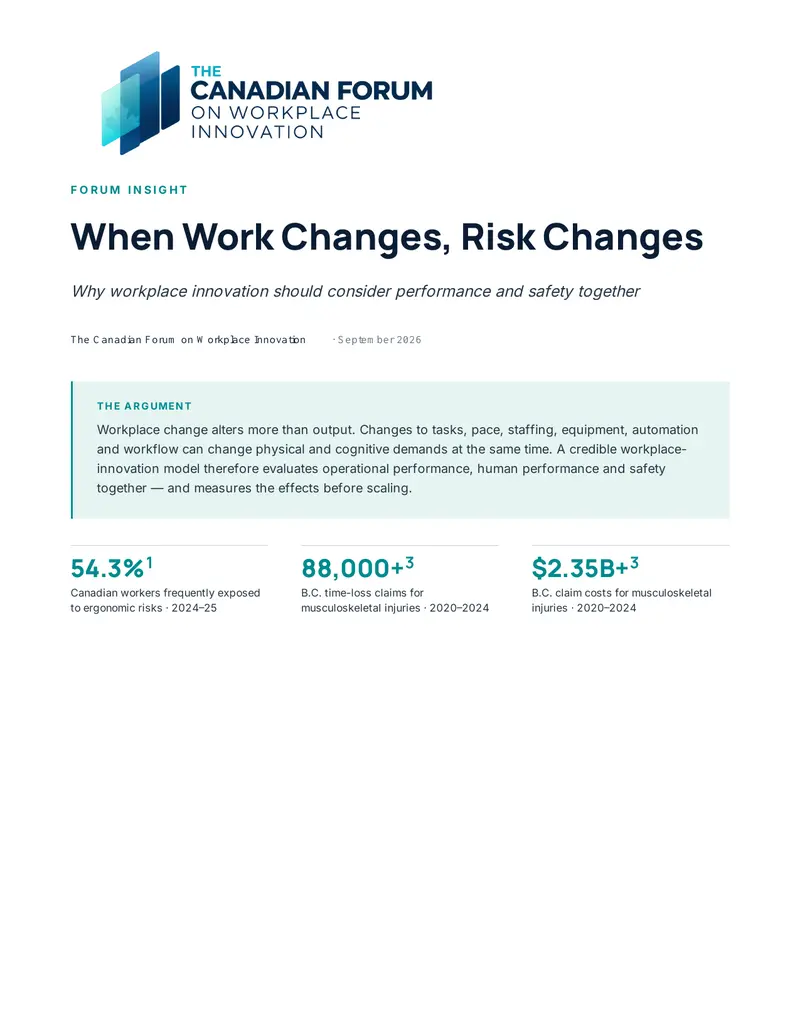
Why workplace innovation should consider performance and safety together
5 pages · PDF