Provincial claims burden
WorkSafeBC reported more than 88,000 accepted time-loss musculoskeletal claims over five years, with more than $2.35 billion in claim costs. One provincial system; not extrapolated nationally.

Forum Insight
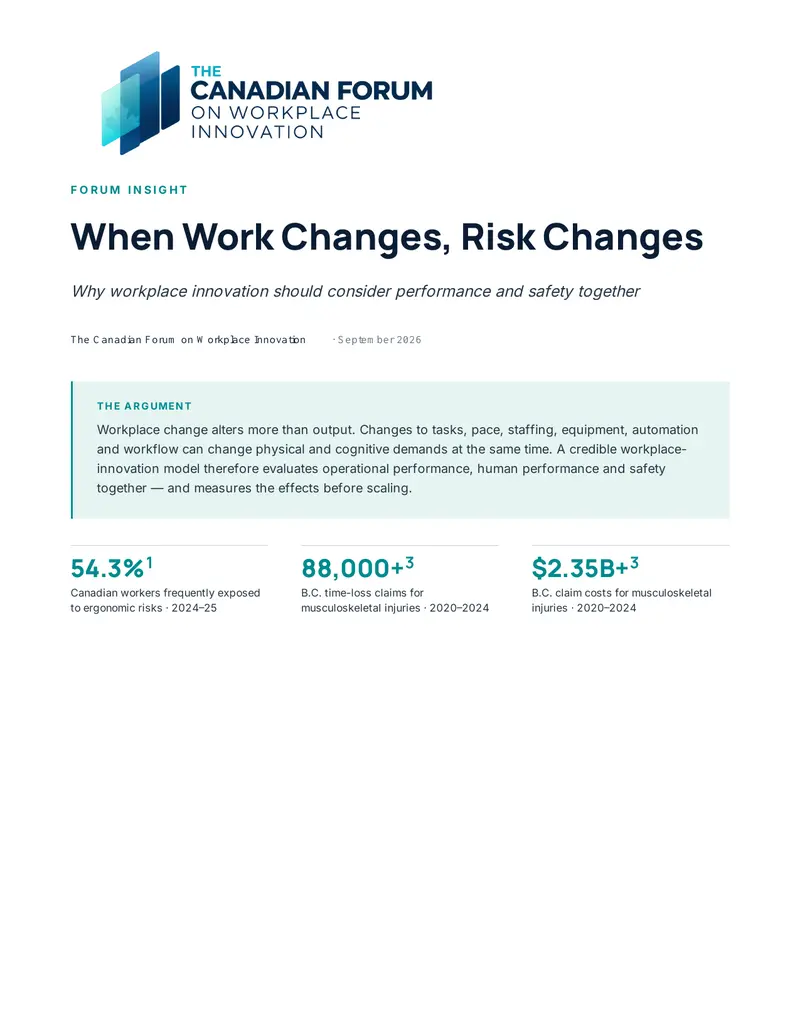
Why workplace innovation should consider performance and safety together
Changes to tasks, pace, staffing, equipment, automation and workflow can alter physical and cognitive demands. This insight explains why performance, human factors and safety should be evaluated together.
September 2026 · 5 pages · PDF
Publication overview
At a glance
54.3%
of workers reported frequent exposure to ergonomic risks
2024–2025 · Canadian workers
Source: Statistics Canada, Canadian Survey on Working Conditions, 2024–2025 (opens in a new tab)
WorkSafeBC reported more than 88,000 accepted time-loss musculoskeletal claims over five years, with more than $2.35 billion in claim costs. One provincial system; not extrapolated nationally.
Define the task, document the baseline, change something specific, measure intended and unintended effects, then decide whether to scale.
Summary
Workplace change alters more than output. A credible workplace-innovation model evaluates operational performance, human performance and safety together — and measures the effects before scaling.
Ergonomic exposure is not a niche issue
Key findings
Ergonomic risks were the most commonly reported physical risk in 2024–2025: 54.3% of workers reported frequent ergonomic exposure, rising to 74.9% in natural resources, agriculture and related production.
WorkSafeBC reported in February 2026 that more than 88,000 time-loss claims for musculoskeletal injuries had been accepted over five years, with more than $2.35 billion in claim costs. These figures describe one provincial system and should not be extrapolated nationally.
Define the task, document the baseline, change something specific, measure intended and unintended effects, then decide whether to scale.
Contents
Evidence and sources
Statistics Canada, Canadian Survey on Working Conditions, 2024–2025 (opens in a new tab)
National exposure estimates.
Canadian Centre for Occupational Health and Safety, Work-related Musculoskeletal Disorders
Canadian ergonomics and WMSD risk-factor guidance.
WorkSafeBC, Musculoskeletal injuries remain the most common workplace injury in B.C. (Feb. 2026)
Provincial claims burden; not extrapolated nationally.
Association of Workers’ Compensation Boards of Canada, statistics and comparability guidance
National compensation-statistics context and comparability limitations.
Institute for Work & Health, Effectiveness of participatory ergonomics
Systematic-review evidence and methodological cautions.
IRSST, ergonomic intervention at the task-design stage
Canadian participatory task-analysis and workplace transformation example.
NIOSH, Elements of Ergonomics Programs
Baseline assessment, job analysis, intervention and evaluation framework.
NIOSH, The Role of Artificial Intelligence in the Future of Work
AI-enabled sensors and computer-vision applications in occupational safety.
ISO 6385:2016, Ergonomics principles in the design of work systems
Human-social-technical systems approach to work design.
Federal, provincial and territorial privacy commissioners, Protecting Employee Privacy in the Modern Workplace
Necessity, proportionality, privacy-impact assessment and human-oversight principles.
Official statistical and regulatory sources are used for core factual claims where available. Survey, think-tank, consulting and international evidence is used as complementary context and is identified by source type. Descriptive associations are not presented as causal effects, and measures with different populations, definitions or reference periods are not treated as directly comparable.
Download
PDF · 5 pages · Forum Insight
Related
Adoption is accelerating. Organizational adaptation is the harder part.
4 pages · PDF
Why lower vacancy pressure does not mean Canada’s workforce constraints have disappeared
5 pages · PDF